
Peachtree City, GA · Garage Door Service
Why Garage Door Springs Snap in Cold Weather in Peachtree City
Why garage door springs snap in cold weather around Peachtree City, GA, where 1980s-90s housing stock meets a cold-moderate climate band every winter.
- Repairs & new doors
- Springs & openers
- Serving 5 nearby communities
What It Costs
We don't quote a spring job over the phone without seeing the door, because the number depends on whether you're running one torsion spring or two, and on the door's weight and size. What we can tell you is what drives the job either way: the spring itself, the labor to wind it under tension, and sometimes a drum or cable that's worn alongside it. Most houses in the Peachtree City service area went up between 1961 and 2007, with the bulk of that stock from the 1980s and 90s, so the hardware we pull off most doors is a fairly standard torsion setup - not exotic, not hard to source. That keeps the job straightforward most days. The honest limitation: if your house is on the older end of that range, built before torsion springs were standard, you may be running an older extension-spring setup, and parts for that take longer to track down than a stock torsion spring. We'll tell you up front if that's what we're looking at rather than quote you a number that assumes the easy version of the job.
Season by Season
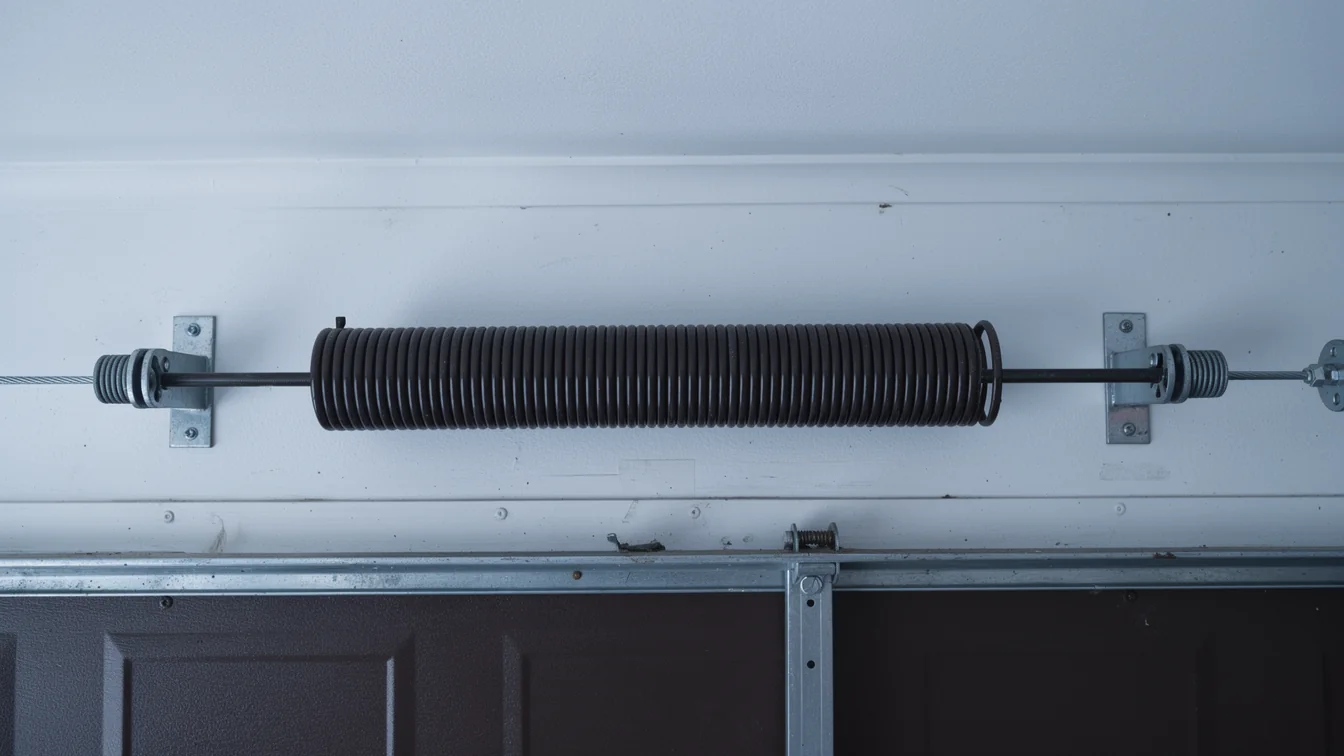
Peachtree City sits in a cold-moderate climate band - not the hard freezes you'd get further north, but enough overnight temperature swings each winter to matter for steel under tension. A torsion spring that's already fatigued from twenty or thirty years of cycling doesn't need a deep freeze to let go; it needs the steel to stiffen and lose a little give on a 28-degree morning, right as someone hits the opener on their way to work. That's the pattern we see here from December through February. Spring and fall are quieter - the swings are gentler and springs that are going to fail tend to hold on a little longer. Summer heat causes its own wear, mostly on openers and weatherstripping, but the spring failures cluster in the cold months. If your door has felt heavier to lift by hand over the last few weeks, or the opener has started straining on the way up, that's usually the spring telling you where it's headed before it breaks outright, and cold mornings are when it finally does.
The Situation
Across the Peachtree City service area there are roughly 21,470 owner-occupied houses out of about 55,441 households total, and a good share of those houses were built during the same two-decade stretch - the 1980s and 90s - when single torsion springs over a standard double door were the norm. That means a lot of garages in town are running springs that are approaching or past the end of a normal service life at roughly the same time, which is why cold-weather calls tend to bunch up rather than trickle in one at a time. With a median household income of $62,381 across the area, most owners here call for the repair rather than attempt a coil-wind themselves, which is the right call - a spring under tension is not a safe DIY job regardless of income or anything else. The same housing-stock pattern extends into the towns around us. Senoia, Tyrone, and Turin, each about six miles out, were built up on a similar timeline, so the failures we see there mirror what we see here.
What Local Conditions Do
Cold doesn't snap a spring on its own - fatigue does that. What cold does is remove the last bit of margin a tired spring had left. Steel contracts slightly as it cools, and a spring that's been flexing through 15,000 or 20,000 open-close cycles since it went in sometime in the 1980s or 90s doesn't have much flex left to give. On a 60-degree October morning, that same spring might hang on another few weeks. On a cold January morning, it's more likely to go. This is why we get more calls in winter without anything dramatic happening weather-wise - no ice storm, no hard freeze, just an ordinary cold morning meeting a spring that was already close to done. If your door is original to a house built anywhere in that 1961 to 2007 window common across Peachtree City, and nobody's replaced the spring since, cold weather is simply the season that's going to find it first.
Frequently asked questions
Why do garage door springs break more in winter?
Cold steel loses a little flexibility, and a spring that's already worn from years of cycling has less margin left. It's rarely the cold alone - it's a tired spring meeting a cold morning at the same time. Houses here built in the 1980s and 90s are often due for a spring right around now, which is why winter calls bunch up.
Can I tell a spring is about to go before it breaks?
Usually. A door that feels heavier to lift by hand, an opener that strains or slows partway up, or a visible gap in the spring coil are all signs. If you notice any of these on a cold morning, don't force the opener - call before it breaks the rest of the way.
Is it safe to replace a torsion spring myself?
No. A torsion spring is wound under enough tension to cause serious injury if it's released wrong. This is one job we'd tell any homeowner, regardless of how handy they are, to leave to someone with the right bars and clamps.
Do you work outside Peachtree City proper?
Yes, we cover the surrounding service area including Senoia, Tyrone, Turin, Brooks, Fairburn, Palmetto, and the other nearby towns within roughly 20 miles, all of which share a similar building era and climate pattern.
Related garage door services in Peachtree City
More garage door guides
Book garage door service in Peachtree City
Call now or request a quote - tell us what the door is doing and where you are.