
Peachtree City, GA · Garage Door Service
Garage Door Opener Repair for Peachtree City Homes
Openers in Peachtree City homes built 1961-2007 wear out from cold-season strain on gears and boards. We diagnose and repair openers across the whole service area, not just swap parts.
- Repairs & new doors
- Springs & openers
- Serving 5 nearby communities
The Symptom
The opener hums but the door doesn't move. Or it climbs halfway, hesitates, reverses, and slams back onto the track. The remote worked yesterday; tonight it's dead no matter how many times you mash the visor button. Some mornings the wall switch only responds after you flip it three or four times.
These aren't random glitches. In houses built across the 1961-2007 stretch that makes up most of this area's stock, the opener itself is often original equipment or a first replacement from the 1990s. Belt drives stretch, chain drives skip a link, and the circuit boards that control travel limits and safety reverse start throwing errors long before the motor itself quits.
If your door reverses before it touches the floor, that's the safety sensor or the down-limit switch, not the spring. If it won't respond to the remote but the wall button still works, that's almost always the logic board or the antenna, not the motor. Knowing which symptom points to which part is most of the job before a tool ever comes out of the truck.
How We Fix It
We start at the header unit, not the door. Power cycle, listen to the motor under no load, then watch what the travel limits actually do when we run the door by hand versus by opener. That tells us in under ten minutes whether we're looking at a gear problem, a board problem, or a sensor alignment problem.
Stripped drive gears get replaced, not greased - grease doesn't fix plastic that's already shaved down. Logic boards with failed capacitors or corroded relay contacts get swapped for a matching board when the part is still made; when it isn't, we'll tell you that straight and talk about full unit replacement instead of chasing a part that doesn't exist anymore.
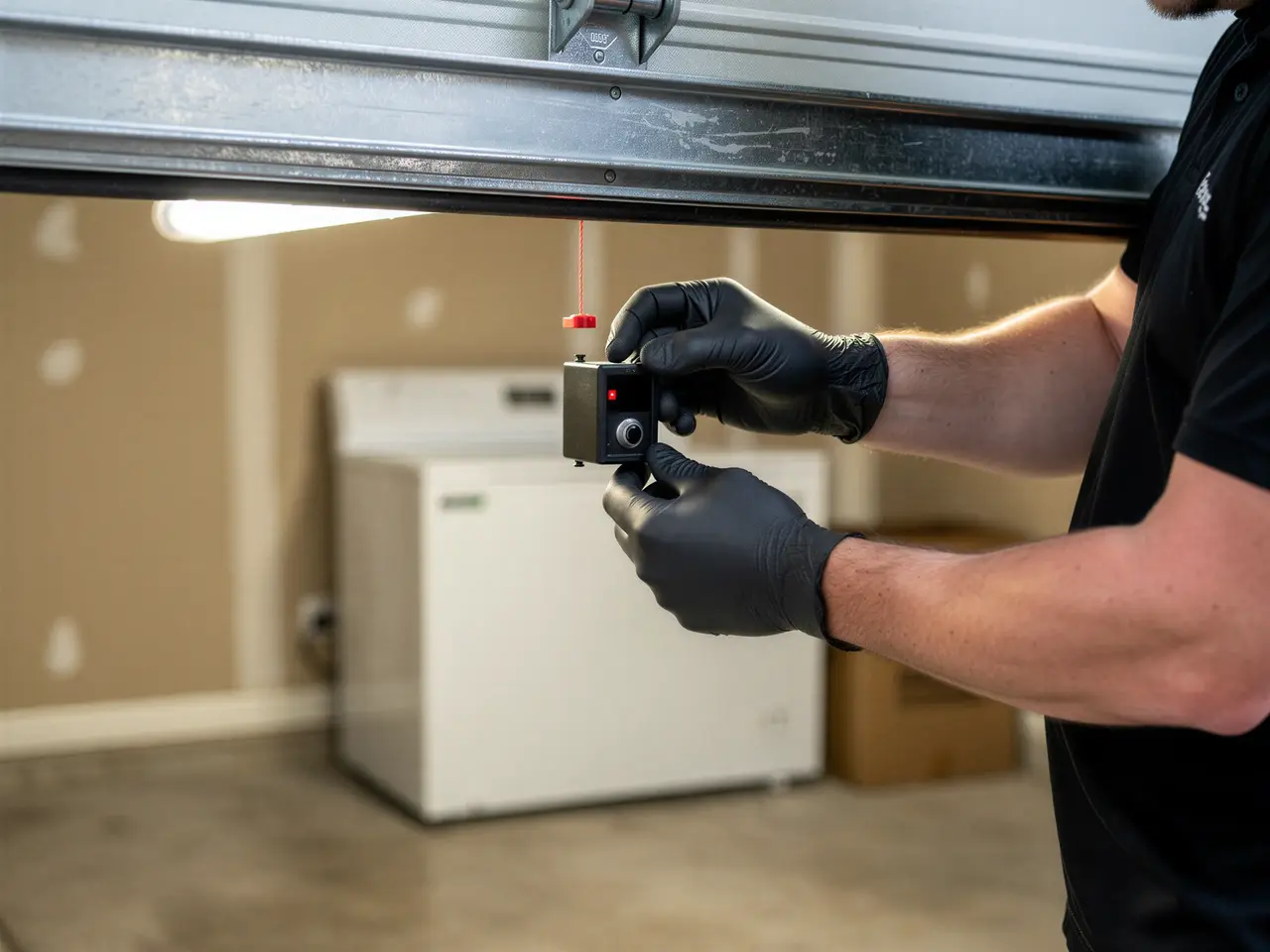
Safety sensors get re-aimed and the wiring checked at the point where it usually chafes, near the bottom bracket. Remotes and keypads get reprogrammed last, after the mechanical side is sound, because a remote fix on a door that's about to strip its gear just means a second call next month.
One honest limit: if the opener is a model where the manufacturer stopped stocking boards years ago, repair can cost close to what a new opener runs. We'll quote both and let you decide.
What Can Go Wrong
The most common failure we see on openers from the 1980s and 1990s stock common to this area is a stripped nylon drive gear - the motor runs, but nothing moves the carriage. Close behind that is a failed logic board, usually from a power surge or just age; symptoms range from random reversing to total unresponsiveness.
Belt and chain openers stretch over the years and start skipping at the sprocket, which shows up as a grinding noise and a door that stalls partway. Safety sensors drift out of alignment from being bumped by a bike or a trash can, and the door won't close at all until they're re-aimed - this one gets mistaken for a dead opener more than anything else.
Battery backup units, where fitted, fail quietly; you don't find out until a power outage and the door won't budge. Capacitors in older boards swell and weep before they fail outright, which is a visible warning sign we check for on every call.
What doesn't usually need fixing: the motor winding itself. In nearly every job we run, the motor outlives the gears, the board, or the sensors around it.
Why It Happens Here
Across this service area - which runs from Senoia and Tyrone out to Fairburn, Palmetto, and College Park - the housing stock is heavily concentrated in builds from the 1980s and 1990s, inside a broader 1961-2007 range. That means a lot of openers are hitting 25 to 35 years old at the same time, all installed when builders used whatever unit came with the door package rather than a premium brand.
The climate here is cold-moderate: not brutal, but enough freeze-thaw swing each winter to stress plastic gears and condense moisture inside housings that were never sealed tight to begin with. That moisture is what corrodes relay contacts on logic boards years before the motor itself gives out.
With roughly 21,470 owner-occupied houses among 55,441 households in the area and a median household income near $62,381, most owners are weighing a repair bill against a full opener swap rather than treating either as an easy yes. That's the math we walk through on every call - not just what's broken, but whether fixing it is the right call for that specific unit's age.
Frequently asked questions
Why does my garage door opener work sometimes and not others?
Intermittent response usually points to a failing logic board or a loose wire at the motor terminal, not the motor itself. Cold mornings make this worse because board components contract slightly, which can open a marginal connection that closes again once things warm up. We test under both conditions when we can.
Is it cheaper to repair my opener or replace it?
Depends on the part. A drive gear or sensor repair is usually far cheaper than a new opener. A failed board on an older unit where the manufacturer no longer stocks parts can push repair cost close to replacement - we quote both before starting any work so you're deciding with real numbers.
My door reverses right before it closes - is that the opener?
Almost always the safety sensors near the bottom of the track, not the opener unit itself. They're required to stop the door if anything breaks the beam between them, and even a slight knock out of alignment will trigger a reverse. Re-aiming them is usually a short fix.
Book garage door service in Peachtree City
Call now or request a quote - tell us what the door is doing and where you are.