
Peachtree City, GA · Garage Door Service
When Your Garage Door Predates the Insulation Code
Most Peachtree City homes went up between 1961 and 2007, before current insulation codes applied to garage doors. Here's what that means for your door.
- Repairs & new doors
- Springs & openers
- Serving 5 nearby communities
What It Costs
There's no single number we can hand you here, and we're not going to pretend otherwise. What a job costs on a Peachtree City door depends on whether you're swapping a single uninsulated panel skin, replacing a full section, or tearing out the whole door for an insulated R-value replacement. A house built in the early 1990s - which covers a lot of this area, since F1/F2 put the bulk of local stock from 1961 through 2007, median around 1991 - usually has a door that was never built with foam core in mind. Retrofitting one is a different job than replacing a door that was already insulated from the factory.
With 21,470 owner-occupied houses across this service area and a median household income near $62,381, we see a wide range of what people choose to spend: some patch the weak point, some replace the whole door and move on. Neither is wrong. What we won't do is quote a number over the phone before we've seen the door, the track condition, and whether the opener is original to the house - on a door this age, that's often the bigger surprise than the panel itself.
Season by Season
This area sits in a cold-moderate climate band, which means you get real winter cold spells but not the kind of sustained deep freeze that cracks a door in half overnight. What it does mean is swing - a door that's fine in July can bind or sag in January because an uninsulated steel skin contracts and expands more than an insulated one does, and on a door built before insulation rules were standard, there's nothing inside the panel to slow that movement down.
Spring and fall are when we see the most service calls, not because the weather is dramatic but because that's when the temperature swings fastest day to night. A single-skin door from the 1980s or 90s flexes with every cold morning after a warm afternoon, and over twenty or thirty years that flexing works on the hinges, the seams, and eventually the rollers. Summer heat is less of a problem for the door itself, though it will tell you fast if your opener's sensors are getting old. Winter is when a door that's been loosening all year finally lets you know, usually as a spring giving out on a cold morning when you need it least.
The Situation
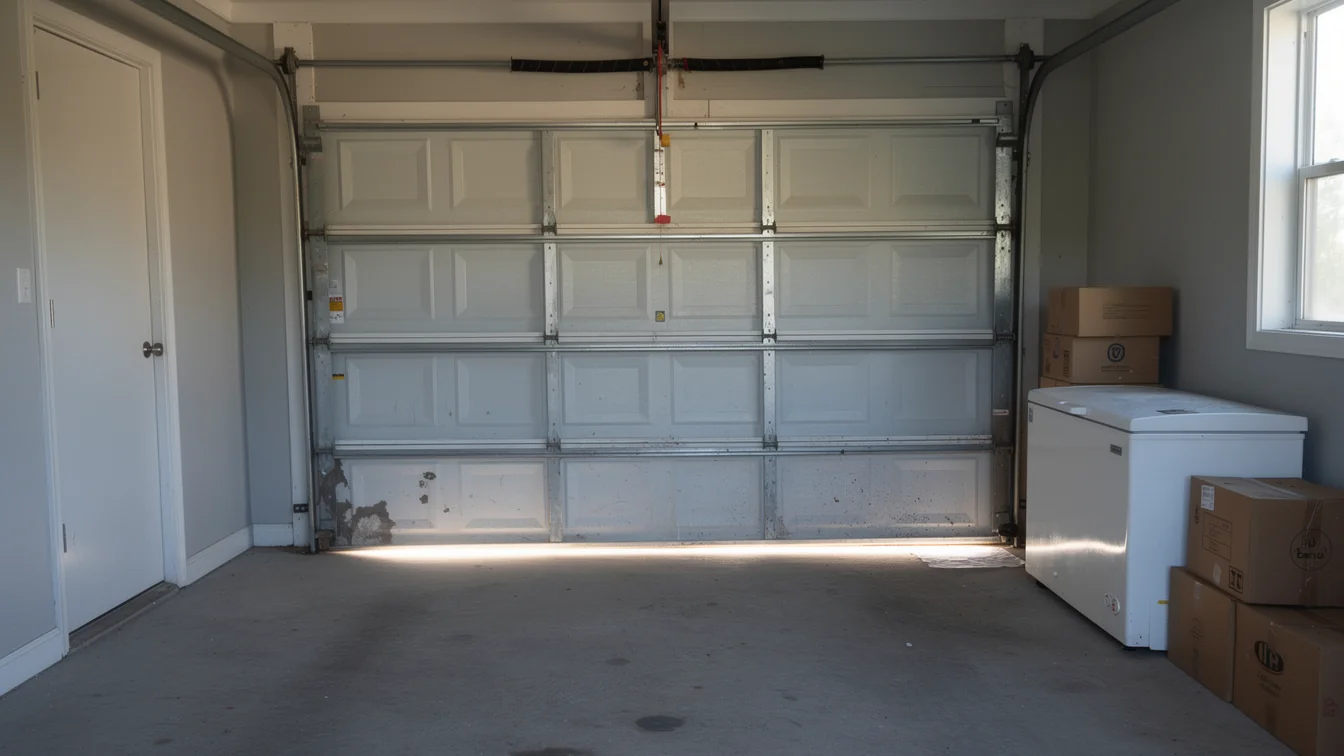
Most of the houses we work on in Peachtree City and the surrounding area - the 20 named sections of local housing stock, per our data - went up between 1961 and 2007, with the bulk of that from the 1980s and 90s. That matters for one reason: insulation requirements for garage doors weren't part of standard residential building code when most of these houses were framed. The door was an afterthought, a steel or aluminum panel bolted onto track, with no expectation it would do any thermal work for the house.
That's not a problem on its own. Plenty of these original doors are still structurally fine, decades later. The issue shows up when someone finishes a room over the garage, or just gets tired of a garage that's twenty degrees colder than the rest of the house, and realizes the door is the weak point nobody budgeted for. We get calls from homeowners within a short drive of Senoia, Tyrone, and Turin - all inside about 6 miles - dealing with the same era of house and the same gap in the original build.
What Local Conditions Do
A cold-moderate climate doesn't destroy an uninsulated door the way a harsh winter region would, but it does something more gradual and more common: it finds every weak seam. Steel contracts in the cold and expands in the heat, and on a door with no foam core backing it, that movement isn't absorbed - it's transferred straight to the hinges, the end stiles, and the weatherstripping at the bottom.
On a house built in the 1991 median window typical of this area, that's thirty-plus years of seasonal flex with no insulation layer to cushion it. We see it most as sag at the top corners, gaps at the bottom seal that let in cold air, and openers working harder than they should because the door itself got heavier to lift as hardware wore loose. None of that means the door has to be replaced - sometimes a stiffener kit and new seal buys years. But if the panel is bowed or the steel's gone thin at the bottom, insulating a door that's structurally tired is money spent on the wrong half of the problem.
Frequently asked questions
Was my garage door ever required to be insulated?
If your house was built in the window most common here - 1961 through 2007, with most stock from the 1980s and 90s - the answer is almost certainly no. Garage door insulation wasn't part of standard residential code for houses of that era, so the original door is very likely a single steel or aluminum skin with no foam core.
Can you add insulation to my existing door instead of replacing it?
Sometimes. If the panels are flat and the hardware is sound, a retrofit insulation kit can work. If the steel is bowed, thin, or the stiles are rusted through, you're insulating a door that won't hold up - in that case replacement is the better money, not the retrofit.
Why does my door get noisier or stiffer in winter?
An uninsulated steel door flexes more with temperature swings than an insulated one. In a cold-moderate climate like this, the worst of it usually shows up in the shoulder seasons, when the day-to-night temperature swing is largest, not during the coldest week of winter.
Do newer houses in this area have the same issue?
Less often. Houses built toward the later end of the local range, closer to 2007, are more likely to have had an insulated door from the start, since manufacturers had shifted that way by then. It still comes down to the specific door, not just the year the house was built.
Related garage door services in Peachtree City
More garage door guides
Book garage door service in Peachtree City
Call now or request a quote - tell us what the door is doing and where you are.